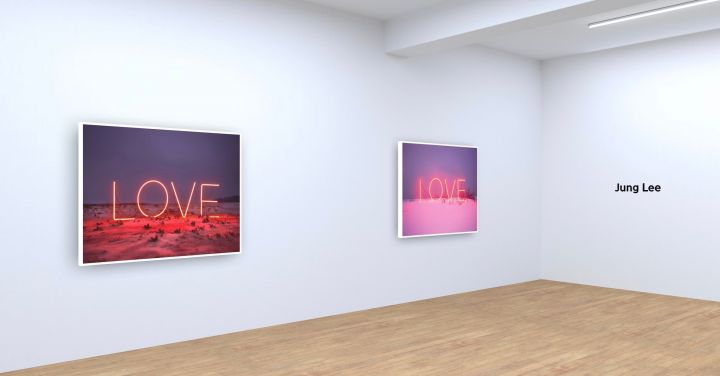
Jung Lee’s online solo exhibition LOVE — A One-Word Journey presents eleven new works alongside LOVE #1, bringing together the latest development of her ongoing exploration of language, light and landscape. Across these works, language is not simply placed within the landscape. It becomes part of it: a physical presence shaped by glass, light, weather and time.
The LOVE series began as an homage to Robert Indiana, who famously described LOVE as a “one-word poem”. Lee takes this idea into a distinctly different territory. Rather than treating the word as a statement, she transforms it into a space of its own. Installed in remote and often wintry landscapes, the illuminated letters appear both emphatic and vulnerable, suspended between declaration and disappearance.
Over time, LOVE has also become a point of departure. Lee’s visual language has expanded into a broader vocabulary that moves beyond love itself, touching on intimacy, longing, ambiguity, understanding and finitude. What begins with a single word gradually unfolds into a wider exploration of language and human experience.
That sense of fragility is also embedded in the medium itself. The red LOVE used in these works was made from thick cold cathode glass tubing, a material and technique that have become increasingly difficult to reproduce. What once appeared repeatable has gradually become singular and finite. For Lee, the “one-word poem” has consequently developed into what she describes as a “one-word journey”.
After many years of working with neon, her attention has shifted increasingly towards the physical nature of the medium itself. Neon is not simply light: it is glass, bent by hand into language, fragile and capable of breaking at any moment. In Lee’s work, something as intangible as a word is therefore given a precarious body. When illuminated within a snowy landscape, language becomes almost tactile. The resulting photograph holds not only the visible scene, but also the physical sensations, tension and experience of the moment in which it was made.
This sense of uncertainty extends to Lee’s use of analogue film. She is drawn to the delay between exposure and development, to the interval in which an image already exists but remains unseen. The latent image becomes a space of expectation, imagination and doubt. The photograph is present, but not yet accessible.
Lee has long used neon to transform text into image. In these new works, however, her interest moves increasingly towards what exists between the two. The process of turning an imagined image into a physical reality is never entirely controllable. Weather, material, light, landscape and film each introduce their own variables. Rather than attempting to eliminate this uncertainty, Lee allows it to remain an essential part of the work.
What emerges is not simply a series of words in landscapes, but a journey through language itself: from declaration to doubt, from intimacy to distance, from presence to disappearance. In Lee’s images, words acquire bodies, landscapes become emotional spaces, and language remains suspended somewhere between what can be seen, what can be felt and what cannot be fully said.
